
NEWS TAG
brand
Floor Gap Fixing Guide - How To Fix Gaps Between Floor and Baseboard, Wall, Tub, or Door Frame
Gaps around your flooring are one of the most common problems homeowners face. They look unappealing, collect dust, and in some cases, they allow moisture or even pests to enter your home. The good news is that most of these gaps can be fixed with basic tools and a bit of patience, no professional contractor required.
Why Do Floor Gaps Form in the First Place?
As your home gets older, the wood inside starts to expand and contract depending on the humidity, the climate, and the temperature changes over time. The wood shrinks and expands, and unfortunately, these are things we cannot control. Eventually, it will happen. If you are lucky, it might not happen at all, depending on the quality or the build of your home.
Your subfloor is made out of wood, or you might have concrete that has settled, and you might have waves. You will not have a perfectly leveled floor. That is why gaps appear between individual floorboards, between flooring and baseboards, between flooring and walls, and between flooring and fixtures like bathtubs.
Below you will find methods and fixes for each type of gap, starting with gaps between the floor planks themselves, then moving to baseboards, walls, door frames, and tubs.
How To Fix Gaps in Your Floor (Gaps Between Floor Planks)
Gaps between floor planks fall into two main categories: gaps in solid hardwood or older timber floors, and gaps in floating floors like laminate or luxury vinyl plank (LVP). The causes are similar — seasonal movement and age, but the repair methods are quite different.
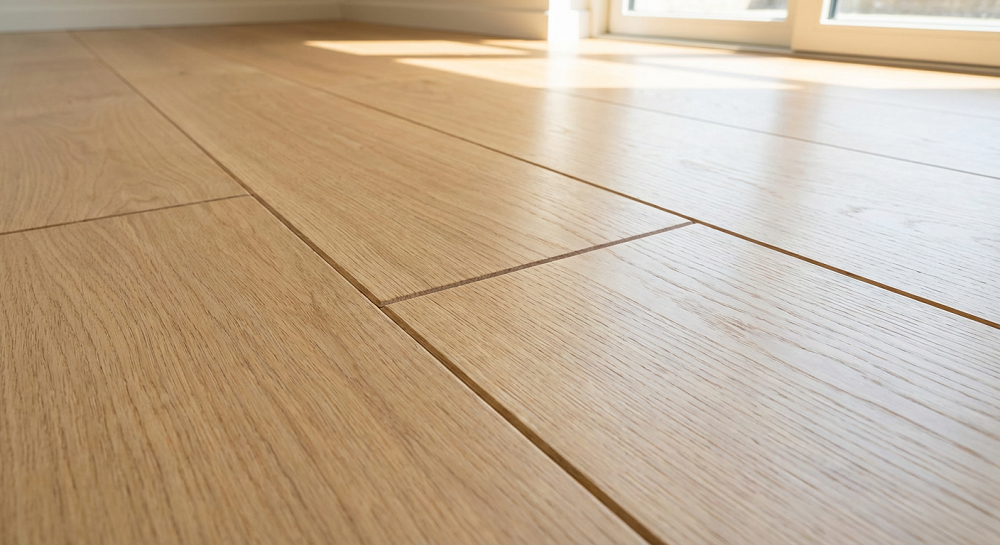
Fixing Gaps in Solid Wood and Hardwood Floors
1. Why You Should Not Use PVA Glue and Sawdust
You have probably read on a forum somewhere to use PVA glue and wood dust to fill floorboard gaps. Do not do that. It is bad advice. PVA glue and sawdust filler is not flexible and it does not move with seasonal expansion and contraction, meaning it probably will not last more than a year. You might get lucky, and sometimes it does last a long time, but most floors that have had this done show it falling out everywhere. It is only held on in a few places.
When the boards compress, the filler gets squashed together. When the boards relax, the filler falls out. That is why it fails.
2. Use Flexible Acrylic Filler Instead
The right product for this job is a flexible acrylic filler. It is designed to move with seasonal expansion and contraction, and you can even choose your color to match the tone of your wood.
For gaps up to about 10mm wide, flexible acrylic works very well, especially if there is still a tongue and groove remaining. Anything in excess of 20mm is more of a gamble. It will still work, but the results are less predictable. You could try it up to 40mm, but there is a limit naturally.
3. Clean Out the Gaps First
Before applying any filler, clean out the gaps thoroughly. Where the gaps have not been previously filled, you can bet that they have been filled with a hundred years' worth of gunk and compressed grime and dirt.
Use a blunt handsaw to clean out the gaps. You can use a multi-tool, but it is best to minimize damage to the surrounding wood. It does not take too long. Mask up as well because it does kick up a bit of dust, and make sure you vacuum thoroughly. You want the gaps nice and clean. This will help the filler stick to the joint, maximize the adhesion, and help it last a lot longer.
4. Applying the Filler
Cut the nozzle to match the width of your gaps. Push the filler into the gap, then wet your finger and run it along the joint to give it a smooth shape. This also slightly recesses the filler below the surface of the wood, which is what you want — when you sand afterward, you will be sanding the wood and not really sanding the filler.
Try to get it right in one pass and do not mess with it. Especially after about five minutes, once the filler starts to go off, you will not get a smooth bead from running your finger over it. If it does not look good, you can always put a little bit of filler over the top and then run your finger down again, but the sooner you do this the better.
5. Timing and Sanding
It is probably best to fill the gaps at the end of day one of sanding and come back the next day. Sometimes waiting about an hour and a half is enough for the filler to set before you sand, but bigger gaps always take longer, and that is worth noting. The filler will not fall out. It will last as long as the floor lasts with regards to needing refinishing, and probably outlast it. At the very least the filler will not fail before the floor needs refinishing.
When sanding, an 80-grit works well to smooth the filler flush with the floor, followed by 120-grit. Make sure you give it a thorough vacuum afterward. Vacuum it and vacuum it again; that should not be underestimated. You do not want dust settling and landing on the finish.
Fixing Gaps in Floating Floors (Laminate, LVP, Engineered)
If you have a floating floor of any sort: laminate, LVP, or some other material with interlocking planks, gaps often arise in winter when things contract. These are typically end-to-end gaps where planks have slowly pulled apart as the weather has gotten colder.
The fix here is not filling the gap but closing it by sliding the planks back together.
Method 1: Double-Sided Tape and a 2x4
You need a 2x4 cut to about 20 inches, with one side sanded to around 220 grit for a nice smooth surface. You also need a hammer and some strong double-sided tape.
Before you start, vacuum out the gap to make sure there is no debris stuck in there. Then look around at your planks to see which ones need to move and in which direction. It might make more sense to move the plank one way rather than the other — for example, if a banister or wall is on one side, you have no room to push in that direction.
Apply two pieces of the double-sided tape to the smooth side of the 2x4. Place the board down on the plank you want to move and press down with your full weight to get good adhesion. Then use the hammer to knock the plank sideways toward the adjacent one. Watch the gap close right up.
You do not want to overdo it, because you could create a little peak where the planks meet. Once the gap is tight, stop.
Closing one gap will create a new gap at the end of that plank, so you need to go to the next plank and repeat the process down the row. At the end of the row near the wall, cut shorter strips of tape, apply them, and use the side of the hammer to hit the plank away from you and toward the wall. A chisel or putty spatula is helpful for prying the 2x4 off the plank when the tape sticks well.
Some high-quality double-sided tapes can be rinsed off in the sink, air-dried overnight, and reused. They come back clean and very sticky, just like new.
Method 2: Painter's Tape and Super Glue (Budget Option)
This method uses the same sanded 2x4, a roll of painter's tape, liquid super glue (not gel), a damp sponge, a small spray bottle of water, a hammer, and a chisel.
Apply painter's tape to the smooth side of the 2x4, overlapping each piece to make sure no glue seeps through. This is especially important on the floor side — you do not want any super glue getting through to the floor surface.
Then apply super glue in a zigzag pattern on one side. On the floor plank, mist the surface with water. The water acts as an activator for the super glue and helps it cure even faster. Press the 2x4 down onto the plank and kneel on it for at least 10 to 30 seconds to form a good bond. Then use the side of the hammer to knock the plank and close the gap, just like the first method.
When you pry the 2x4 off, the glue often holds the tape together, so you can reuse the whole piece by just sticking the tape back down and moving to the next plank.
How To Fix the Gap Between Floor and Baseboard?
Gaps between flooring and baseboards are a very common problem because your subfloor is rarely perfectly level. You install your flooring, then install your baseboard, and you end up with gaps between the two. There are several ways to handle this, from quick and easy to more involved.
Method 1: Press the Baseboard Down with Weight
One very easy and cheap trick is to find a piece of plywood large enough to put your knee on. Place it right on the very edge of your baseboard. Before you attempt this, make sure you assess your baseboard. Most of the time there is caulking on top, and you will need to score or cut that caulking with a utility knife or razor blade to loosen up the baseboard first.
This method might not work for everybody, because sometimes baseboards are nailed onto their studs with strong nails, and it is very hard to press them down. But if your baseboard is secured with 18-gauge brad nails, they are not that strong, and with enough weight they will bend. Apply your weight on the plywood, and you will notice the baseboard starting to go down. Then use a brad nailer to shoot a nail and hold it in the new position.
Sometimes you get lucky and it is that easy. Other times the brad nails are dug in deep and you might have to find them and remove them with pliers before you can push the baseboard down. Then you will have to patch the damage with some wood filler, sand it, and repaint it.
Method 2: Install Quarter Round or Shoe Molding
This is probably the first solution most people think of. You can easily find quarter round or shoe molding in the trim section at your local hardware store. Quarter round is even on each side, while shoe molding has one side longer than the other.
Place it right against the bottom of your baseboard. It will have a little bit of gap on the bottom, but when you press down in the middle it will follow the contour of your floor. From a normal viewing distance it is not very noticeable. Use a brad nailer to shoot nails in at different areas along the trim.
The downside is that if you install this in one spot, you will need to run it along the entire baseboard to make it look uniform throughout the perimeter of the room. It is not that expensive per piece, but the cost does add up over a full room or an entire home. You also have to paint them — some come pre-primed but they still need a finish coat.
Method 3: Caulk the Bottom of the Baseboard
This method is very easy to do. The key is choosing the right type of caulking. For indoor use, a flexible stretch caulking works best because it stretches a lot and allows for expansion and contraction. When you have floating floors or hardwood floors, the floor is going to move back and forth over time, and you want a caulk that can withstand that movement.
Also take note that caulking comes in many different colors. Use a color that matches your flooring or baseboard, and play around to see what blends best with your setup.
Run a bead of caulk along the bottom edge of the baseboard where it meets the floor. Keep a damp rag nearby so you can wipe off excess caulk as you go and create a clean, smooth line.
Method 4: Remove the Baseboard and Scribe It to Fit (For Large Gaps)
If the gap is large or very uneven, and you want a permanent fix, you can remove the baseboard, scribe it to match the contour of the floor, cut away the excess material, and reinstall it.
Removing the Baseboard
Before you pry it off, cut the caulking along the top edge with a utility knife. Then use a pry bar or a tool with a beveled edge. Place a piece of scrap wood against the wall as leverage so you do not damage the drywall, and gently pry the baseboard off, working your way from one end to the other. Once it is off, remove all brad nails from the baseboard.
Shimming and Leveling
Set the baseboard against the wall and put shims underneath to bring it level. Calculate the deepest dip or bow in your flooring and use shims of that thickness. Place a level on top of the baseboard and adjust the shims left or right until it reads perfectly centered. Use masking tape to hold the baseboard in position while you work.
Scribing the Contour
Use a compass (the kind with a pencil and a pointer) to trace the profile of the floor onto the bottom of the baseboard. Place the bottom portion of the compass flat on the floor at all times while you drag it across. Do not lift it or move it up and down, or your measurement will be off. Run it across one or two times in the same direction to make sure the line is accurate.
Everything below the scribed line will be removed. The line will taper off to nothing where the floor is high, and it will show more material to remove where the floor dips.
Cutting and Sanding
For thinner areas, use a belt sander to remove material down to the scribed line. For thicker sections, use a jigsaw to cut close to the line without going over it, and then finish with the belt sander to smooth and level the edge.
Reinstalling
Place the scribed baseboard back against the wall and check the fit. The bottom edge should now follow the contour of the uneven floor and sit flush. Use a level on top to confirm everything is even. If there is still a tiny gap somewhere, you can take the baseboard off and sand a little more. Once you are satisfied, nail it back in, caulk the top edge, touch it up with paint, and you are done.
Method 5: Fix the Floor Underneath (Vinyl Plank and Laminate Only)
If the gap is caused by a dip or hollow spot in the floor rather than an uneven baseboard, and you have vinyl plank or laminate flooring, you can try filling the void underneath.
Push down on different areas near the baseboard to find where the floor feels hollow. Mark the boundaries of the hollow spot with masking tape. Then drill a small hole through the flooring at the appropriate location and use a syringe to inject caulking into the void underneath. This raises the floor back up and closes the gap from below.
This method will not work for everybody. Make sure you check the warranty on your floor before drilling — if your floor is still under warranty, this could void it. The hole can be disguised afterward by soldering or capping it if you are working with a plasticky material like vinyl plank.
How To Fix the Gap Between Floor and Wall?
Sometimes the gap is not between the floor and the baseboard but between the baseboard and the wall itself. This happens when the wall is uneven, bowed, or has settled over time. If you try to just fill this kind of gap with caulking, it looks very bad, especially if you have two-toned colors where your baseboard is white and your wall is a different color. You will really see that difference, and it just does not look good.
1. Assess the Size and Shape of the Gap
Take a 12-inch drywall knife and place it against the wall. You can see where the gap starts, where it is deepest, and where it starts to taper off. Move the knife left to right and up and down to map the unevenness. This tells you how large an area you need to treat.
2. Mask Off the Baseboard
Because you are going to be filling the gap and feathering joint compound onto the wall, mask off the top of the baseboard with painter's tape to protect it from compound getting on it.
3. Apply Joint Compound
Use a setting-type joint compound: 20-minute, 45-minute, or 90-minute mud. This gives you enough time to work with it before it sets.
Load up your six-inch drywall knife with joint compound and start filling the void where the wall is uneven. Push the compound into the gap between the wall and the top of the baseboard. Then use light pressure on the knife and start feathering the compound upward onto the wall.
Do not push too hard — that will just squeeze out all the joint compound you built up, and you will lose the flush look. It is all about finessing. Take your time, use light pressure, and work in back-and-forth and up-and-down motions.
4. Feather with a 12-Inch Knife
Once you have enough compound in the gap and worked up the wall, switch to your 12-inch knife. Place it against the wall to see where you still need to fill low spots. Add a little more compound where needed, then use the 12-inch knife to feather everything smooth from bottom to top.
Your hand placement matters here. Do not grip the knife handle tightly. Place your thumb on top, your index finger on the bottom, and just lightly apply pressure from bottom to top. You will find your rhythm once you get going.
5. Remove the Masking Tape Immediately
Right when you finish smoothing, remove the masking tape while the compound is still wet. If you let it dry and then pull the tape, there is a chance you will take out a flake or cause chipping on the edge.
6. Sand and Texture
After the compound has fully dried, lightly sand with 180-grit sandpaper or a sanding block. Do not go too hard — you do not want to remove all the work you just did. Focus on feathering the top edge where the new compound meets the old wall surface, because that is where it will look obvious if you do not blend it correctly.
Vacuum all the dust from the wall and wipe it down with a damp rag. Then apply texture to match the existing wall finish using a hopper gun or texture spray loaded with thinned joint compound. Feather the texture so it blends in with what is already there. Remove any masking tape before the texture dries.
7. Finish with Caulking and Paint
Once the texture is dry, run a bead of caulking along the top of the baseboard where it meets the wall for a clean, uniform look. Then paint to match the surrounding wall. The result should be a smooth, even surface with no visible gap.
How To Fix the Gap Between Floor and Door Frame?
Gaps between flooring and a door frame (or door casing) tend to show up when new flooring is installed at a different height than the old floor, or when the house settles and shifts over time.
1. Small Gaps (Under 5mm)
For small gaps, a color-matched caulk is the simplest fix. Use a flexible, paintable caulk that can handle some movement. Apply a thin bead along the base of the door frame where it meets the floor, then smooth it with a damp finger or a caulk finishing tool. Wipe away excess with a damp rag before it dries.
2. Medium Gaps (5mm to 10mm)
If the gap is a bit wider, flexible acrylic filler or latex caulk alone may not hold well enough. In this case, consider using a foam backer rod first. Push the backer rod into the gap to fill most of the void, and then apply caulk over the top. The backer rod gives the caulk something to grip and prevents it from sinking into a deep gap.
3. Gaps Caused by a Height Difference
If the flooring does not reach under the door casing and there is a visible gap at the bottom of the frame, the best approach is to trim the bottom of the door casing so the flooring can slide underneath. Use an oscillating multi-tool or a flush-cut saw with a piece of flooring as a height guide. Cut the casing at the correct height, slide the flooring underneath, and seal any remaining small gaps with caulk.
4. Finishing Touches
Whatever method you use, make sure the caulk or filler you choose is paintable if the door frame is painted. Once the filler has cured, touch it up with matching paint for a clean appearance.
How To Fix the Gap Between Floor and Tub?
The gap between flooring and a bathtub or shower base is more than a cosmetic issue — it is a potential water entry point. If water gets into this gap regularly, it can damage the subfloor, promote mold growth, and even let pests into your home.
Usually you want about an eighth of an inch to a quarter of an inch gap between floating flooring and a tub or shower. That is because the floor needs the ability to flex and move, and that is pretty standard with all floating floors. The gap becomes a problem when it is too large or when it is not sealed properly.
Method 1: Silicone Sealant Alone (For Small Gaps)
One approach is to fill the gap with a silicone-based sealant. Make sure it is a true silicone product, not your standard window sealant or acrylic caulk. Silicone stays flexible, which allows the floor to still move.
The drawback is that it does not always look very good. Usually, all you see is the silicone, and you will still notice the gap or see a white strip between the floor and the tub.
Method 2: PVC Trim with Silicone (Recommended for Most Situations)
A cleaner approach is to install a piece of PVC trim — usually quarter round or a slim profile molding. You can find this at your local hardware store.
Measure the length of the gap along the tub and cut the PVC trim to fit. If you have a miter saw, use that. Shears or even a pair of wire cutters will work for thinner trim. Set the piece in place to check the fit before applying any adhesive.
Run a bead of silicone along the back side of the trim — the side that will go up against the tub or shower, not the side that goes against the floor. Press the trim into place and run your finger along the top to make sure the silicone fills the gap between the trim and the tub. That joint is where you need it to be watertight.
Once the trim is in position, apply strips of painter's tape to hold it in place while the silicone cures. It takes about 24 hours to fully cure, so do this at a point where the area will not get wet for at least a full day. After the cure time, come back and check for any remaining gaps. If you find any, fill them with another small bead of silicone.
Method 3: Shower Dam with Expanding Foam (For Large Gaps)
If you have a really large gap, for example, where a shower floor has sunk down over time — standard silicone alone cannot bridge the distance. Silicon cannot bridge a gap that big, and it will not fully seal it. Water can get under the house, and pests like millipedes and slugs can come up through the opening.
A product called a shower dam works well in this situation. It is a solid silicone strip that sticks to the floor and acts as a barrier. Choose one that is solid in the middle rather than hollow for better performance.
Before you stick anything down, remove all old silicone and clean the area thoroughly. If you get a second chance at this, scrub it down with bleach or vinegar to kill any algae or mold that was growing around the gap. Cut the shower dam to size and check that it fits into the space.
Where the gap is narrow, put a bead of silicone behind the shower dam to make sure the gap is fully blocked, then stick the dam in front of it. Where the gap is wide, use expanding foam to fill the void first. Apply the expanding foam, then stick the shower dam over the top while the foam is still wet. Wipe off any excess expanding foam immediately.
Let the expanding foam dry according to the packaging instructions. If any foam bubbles out past the dam, cut it off with a utility knife once it has hardened.
The final step is to apply silicone on both the top edge and the bottom edge of the shower dam to make sure the whole assembly is fully waterproof. Let everything cure completely before allowing water near the area.
Maintenance After the Fix
Over time, algae or mold can grow on the shower dam strip, especially in a wet bathroom environment. Using bleach gel (the kind used for cleaning toilets) can clean it off effectively. Some discoloration between the silicone caulking and the dam may remain, so if you are doing this job from scratch, consider wiping the whole shower dam down with bleach gel before applying the silicone caulking.
Also check the edges of the shower where the dam or foam meets adjacent walls. If you find gaps on the outside edge of the shower that are not directly hit by water, expanding foam sealed with silicone on top is a practical solution for those areas as well.
No matter which type of gap you are dealing with, a few principles apply across the board. Always clean the gap thoroughly before filling it: dust, grime, and old caulk will prevent new material from sticking. Choose flexible products that can move with your floor over time, because rigid fillers will crack and fall out. And give your sealants and adhesives the full cure time before exposing them to traffic or moisture. A little patience up front saves you from having to redo the job six months later.