
NEWS TAG
brand
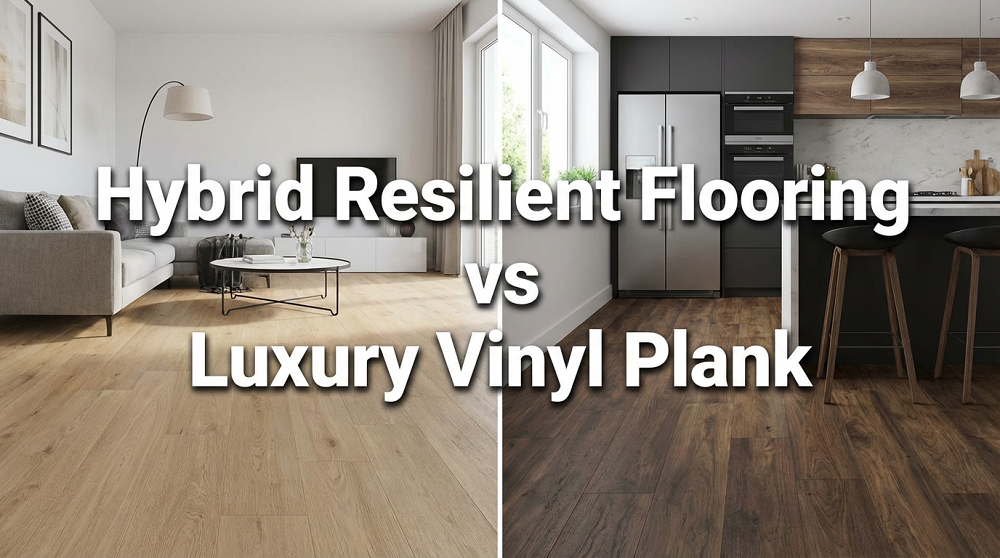
Hybrid Resilient Flooring vs Luxury Vinyl Plank: Pros, Cons, Price, Uses, Installation
Choosing new flooring can feel overwhelming with so many products on the market today. Two of the most popular options, hybrid resilient flooring and luxury vinyl plank (LVP), share some similarities but differ in composition, performance, and ideal use cases. In this blog, we will walk you through everything you need to know about both flooring types so you can pick the right one for your home or commercial space.
1. What Is Hybrid Resilient Flooring?
Hybrid resilient flooring is a newer flooring category that has grown into one of the largest and most popular segments in the residential market over the past five to six years. As the name suggests, it is a "hybrid", borrowing elements from both vinyl plank flooring and laminate flooring and combining them into a single product.
From the laminate world, hybrid takes its click-lock joining system and floating floor installation method. From the vinyl world, it takes its picture film (decor layer) and wear layer. The result is a product that installs quickly, handles moisture well, and delivers a remarkably realistic timber-look finish.
Two Core Types
There are two primary core types within the hybrid category:
SPC (Stone Plastic Composite): A dense, solid core composed mainly of limestone bound with PVC. Heavy, rigid, and very stable.
WPC (Wood Plastic Composite): An aerated or foamed core that is lighter but somewhat less rigid.
Since the category first launched, additional terms have appeared: IPC, APC, ESPC, but these are all variations that orbit around those two foundational core types.
What Is Hybrid Resilient Flooring Made Of?
Hybrid resilient flooring is built from multiple layers, each serving a specific function. From bottom to top, a typical hybrid plank includes the following components:
Backing / Underlay Layer
Pre-attached to the bottom of each plank, this is usually a cushioned rubber or cork pad. It means you do not need to purchase or install a separate underlay. It provides comfort underfoot, sound dampening, and a degree of thermal insulation.
Core Layer
This is the structural body of the plank.
In SPC hybrids, the core is predominantly limestone (calcium carbonate) held together with PVC as a binding agent. This produces a dense, heavy, and dimensionally stable board.
In WPC hybrids, a foaming agent is introduced during extrusion, creating an aerated or honeycombed core, think of it as the difference between a solid block of chocolate and an Aero bar. WPC cores are lighter but also less rigid.
The core is where the click-lock joining mechanism is machined. Thicker cores (eight to nine and a half millimetres) allow for stronger, more robust joins.
Decor / Picture Film Layer
A high-resolution printed vinyl layer that gives the plank its visual appearance — typically a timber grain pattern. Modern printing technology produces extremely realistic images, and pattern repeats can range from one in eight planks to over one in thirty, with less repetition producing a more natural-looking floor.
Wear Layer
The topmost clear coating that protects the decor film from scratches, stains, scuffs, and daily traffic. Wear layers vary in thickness and quality. Because the wear layer is PVC-based, it can be sensitive to extreme heat and prolonged direct sunlight, which may cause expansion, contraction, or fading over time.
Hybrid Resilient Flooring Pros & Cons
Pros
Waterproof performance. The PVC and limestone composition means hybrid flooring is fully waterproof. Spills, splashes, and pet accidents can be wiped up without fear of damage, a major advantage over laminate and hardwood.
Built-in underlay. Every plank comes with underlay pre-attached, simplifying installation and reducing overall project costs.
Easy, quick installation. Planks click together as a floating floor without glue, nails, or chemicals. The process is within reach of most confident DIY homeowners.
Realistic timber appearance. Registered embossing, where the surface texture aligns precisely with the printed grain, makes many hybrid floors nearly indistinguishable from real timber.
Durability for busy households. Handles children, pets, scooters, and high foot traffic well. Not scratch-proof or stain-proof, but performs considerably better than many other flooring types under heavy daily use.
Low maintenance. Regular sweeping or vacuuming plus a damp mop with a vinyl-safe cleaner is all that is needed. No waxing, polishing, or refinishing required.
Comfort and sound dampening. The dense core plus cushioned underlay gives a comfortable feel underfoot. Thicker, heavier hybrids sit more firmly and feel noticeably more solid.
Cons
Susceptibility to extreme heat and UV. Prolonged exposure to intense direct sunlight can cause planks to expand, lift, or fade, particularly near large windows or glass doors.
Not scratch-proof. Sharp objects, heavy furniture without protective pads, or dragging items across the surface can still scratch or gouge the floor. Darker colours show scratches more visibly.
Weight (SPC products). Solid-core SPC hybrids are roughly 2.5 times heavier than laminate of the same thickness, adding to freight costs and physical effort during installation.
Joint integrity over time. Thinner products, especially those with higher plasticizer content in the core (often identifiable by a whiter core colour), have experienced joint failures several years after installation.
Hollow sound. As a floating floor, hybrid can produce a somewhat hollow sound underfoot, particularly with thinner planks. Heavier, thicker boards reduce this but do not eliminate it entirely.
Aerated core trade-offs. Lighter WPC/IPC/APC hybrids reduce weight and cost, but their honeycombed structure weakens the joins. A ten-millimetre aerated-core hybrid may deliver only the same join strength as a six-millimetre solid-core product.
Hybrid Resilient Flooring Price
Hybrid resilient flooring is one of the more affordable hard-flooring options available. In Australia, a typical hybrid floor ranges from approximately $30 to $70 per square metre installed, including professional labour. DIY installation brings the cost down further since no separate underlay purchase is needed.
What Affects the Price?
Prices vary depending on core type (SPC vs WPC), plank thickness, wear layer quality, brand reputation, and design realism. Thicker SPC products with premium embossing and high-mil wear layers sit at the upper end. Thinner entry-level options are more budget-friendly.
When long-term costs are factored in, low maintenance, no separate underlay, and strong durability, hybrid flooring often represents strong value compared to hardwood, engineered timber, or natural stone.
Hybrid Resilient Flooring Applications - Where to Use
Residential
Hybrid flooring's waterproof nature and durability make it suitable for virtually every room in a home:
Kitchens, bathrooms, and laundry rooms - where moisture, spills, and heavy traffic are everyday realities.
Living rooms, bedrooms, and hallways - the realistic timber look allows it to run seamlessly through an entire home.
Basements and below-grade areas - the PVC and limestone core will not swell or rot from ground moisture the way timber or laminate can. Some manufacturers recommend placing a plastic moisture barrier over concrete slabs to preserve the warranty.
Light Commercial
Offices, retail showrooms, and reception areas with moderate to high foot traffic are good fits for hybrid. For very heavy commercial use (restaurants, supermarkets), a commercial-grade glue-down vinyl product may be more appropriate.
Caution: Sun-Drenched Rooms
Sunrooms, conservatories, or rooms with floor-to-ceiling glass require care. UV radiation and heat can cause PVC-based products to expand or discolour. Window treatments, UV-filtering glass, or thicker planks with UV-resistant wear layers are advisable.
Hybrid Resilient Flooring Installation
Installing hybrid resilient flooring is a straightforward process that many homeowners can complete as a DIY project, though hiring a professional ensures a polished result and preserves warranty coverage.
Step 1: Prepare the Subfloor
This is the most important step. The subfloor must be flat, not necessarily perfectly level, but flat.
The industry standard is no more than 3 mm deviation beneath a 1.5-metre straight edge.
Grind or sand down high spots. Fill low spots with a levelling compound.
Check the subfloor in multiple directions, both parallel and perpendicular to the board direction.
Poor subfloor prep voids warranties and causes bouncy floors, stressed joins, and premature failure regardless of product quality.
Step 2: Lay Moisture Protection (If Required)
Some manufacturers specify a plastic sheet or moisture barrier over concrete slabs. Even if not mandatory, it is a sensible precaution, especially on ground-level or below-grade concrete. The barrier also prevents the rubber underlay from gripping the concrete, which can interfere with the floating action.
Step 3: Plan Direction and Layout
Start along the longest wall and lay boards in the direction of the incoming natural light for the most visually appealing result. Open several boxes at once and sort planks to identify repeating patterns. Keep identical or similar patterns well separated. Aim for a minimum of 300 mm between end joints in adjacent rows. Avoid staircase or brick-like patterns; randomised staggering looks the most natural.
Step 4: Lay the First Row
Begin in a corner and place spacers (8–12 mm) along the walls to allow for expansion. Position the first plank with the groove side facing outward into the room. Click subsequent planks together at the short ends. Accuracy in this first row is paramount; any misalignment compounds as the floor progresses.
Step 5: Continue Row by Row
Insert the long edge of each new plank at roughly 45 degrees into the groove of the previous row, then press flat. Use a tapping block and rubber mallet to close gaps. Never use a standard hammer, it damages the click-lock profile. For the final plank in each row, use a pull bar to draw it tight against the previous plank.
Step 6: Cut Planks as Needed
Straight cuts: Score along a straight edge with a utility knife three or four times, then snap.
Complex cuts (around vents, door frames, irregular walls): Use a jigsaw.
Under door trim: Use a flush-cut saw or oscillating multi-tool to trim the bottom of the architrave so the plank slides underneath cleanly.
Step 7: Install Transition Trims
C-channel, T-moulding, or other transition profiles are installed at doorways and where the floor meets other surfaces. These are typically glued or screwed into place, with the hybrid plank tucked into or under the trim.
Step 8: Finish Up
Remove all spacers and install skirting boards or baseboards around the perimeter to conceal the expansion gap. The floor is then ready for furniture and daily use.
2. What Is Luxury Vinyl Plank?
Luxury vinyl plank, commonly abbreviated as LVP, is a type of resilient flooring designed to replicate the look and feel of natural hardwood, and sometimes stone, while offering greater durability, easier maintenance, and better moisture resistance.
Unlike the sheet vinyl of decades past, modern LVP features a sophisticated multi-layer construction and comes in individual plank-shaped pieces that mimic the size and shape of traditional hardwood boards.
LVP Flooring Types
LVP has been on the market for considerably longer than hybrid flooring, and the category is wide. It includes:
Glue-down solid vinyl planks - used extensively in commercial settings, bonded directly to the subfloor with pressure-sensitive adhesive.
Click-lock floating vinyl planks - with rigid SPC or WPC cores, the most common residential product and the closest comparison to hybrid flooring.
Loose-lay products - planks that sit on the subfloor under their own weight, with a special friction backing. Individual planks can be pulled up and replaced without disassembling the floor.
LVP comes in a vast spectrum of colours, patterns, and finishes, from classic oak and walnut to exotic species and rustic weathered barnwood, allowing homeowners to achieve a high-end appearance at a fraction of the cost of natural materials.
What Is Luxury Vinyl Plank Made Of?
Luxury vinyl plank is constructed from several distinct layers, each contributing to the product's performance and appearance:
Backing Layer
The bottommost component. Many click-lock LVP products include a thin cushion or rubber pad pre-attached for sound dampening and comfort. Glue-down and some budget products often do not, in which case a separate underlayment may be recommended.
Core Layer
The core gives the plank rigidity and structure, and it varies by product type:
SPC (Stone Plastic Composite): Limestone dust and PVC pressed under immense pressure. Very dense, heavy, and rigid.
WPC (Wood Plastic Composite): Wood fibre and plastic polymers. Slightly lighter and more flexible.
Solid vinyl (no composite core): Vinyl from top to bottom. Used primarily in commercial glue-down applications and relies on adhesive bonding for stability.
Design / Decor Layer
A high-resolution printed film that carries the visual identity of the plank: wood grain, knots, colour variation, and character marks. Print quality varies considerably across brands and price points. Premium products feature embossed-in-register (EIR) technology, where the physical texture on the surface aligns precisely with the printed grain for a startlingly realistic look and feel.
Wear Layer
The clear protective coating on top, what you actually walk on. It serves as the primary defence against scratches, scuffs, stains, and daily wear.
Wear layers are measured in mils (thousandths of an inch):
6 mil: Found on the cheapest products. Not recommended.
12 mil: Considered a residential baseline.
20 mil: The sweet spot for households with children and pets.
30–40 mil: Premium and commercial-grade options for heavy-use environments.
Higher-density wear layers provide better protection than softer alternatives of the same thickness, so composition matters just as much as the number.
Luxury Vinyl Plank Pros & Cons
Pros
Impressive aesthetics. Modern printing and embossing make LVP nearly indistinguishable from real hardwood. The range of colours, textures, and plank sizes is enormous.
Strong durability. Engineered to handle heavy foot traffic, pets, and children. Many brands offer warranties spanning 10 to 30 years.
Water resistance or full waterproof performance. Unlike hardwood, LVP will not swell, warp, or stain from moisture exposure. SPC and WPC products can be installed in kitchens, bathrooms, basements, and laundry rooms.
Comfortable and quiet underfoot. Multi-layer construction and attached underlayment provide a softer, warmer surface compared to tile or stone, along with sound dampening.
DIY-friendly installation. Click-and-lock or loose-lay systems require no glue, mortar, or specialised tools. Planks can often be cut with a utility knife.
Affordable relative to natural materials. More expensive than basic sheet vinyl or carpet, but far less than hardwood, engineered timber, or natural stone. Long-term maintenance costs are low.
Low maintenance. Regular sweeping or vacuuming and occasional damp mopping with a mild pH-neutral cleaner. No waxing, sanding, or refinishing.
Cons
Vulnerable to gouging and heavy impact. Sharp objects and heavy furniture dragged without protective pads can permanently mark the surface. Damage to the wear layer cannot be repaired without replacing the plank.
Potential for fading under direct sunlight. Some products discolour under prolonged UV exposure. UV-resistant coatings are improving but remain a consideration.
Perceived value compared to real wood. LVP may not carry the same prestige or resale appeal as genuine hardwood in high-end markets, though this perception is shifting.
Environmental concerns. Primarily composed of PVC and synthetic materials. An increasing number of manufacturers are pursuing certifications like FloorScore or GreenGuard, but eco-conscious buyers should research brands carefully.
Subfloor prep is non-negotiable. The subfloor must be completely flat and dry. Bumps, dips, or moisture lead to buckling, lifting, and joint failure — a step often underestimated by DIY installers.
Not all products are equal. The quality range is vast. Budget products with thin wear layers, soft cores, and poor printing will not perform anywhere near as well as premium options.
Luxury Vinyl Plank Price
LVP pricing varies widely depending on core type, wear layer thickness, brand, and design quality.
Typical Material Costs (US Market)
Budget products: Under USD $1 per square foot (thin wear layers, basic prints)
Mid-range (best value): USD $2–$4 per square foot
Premium lines: USD $5+ per square foot (thick SPC cores, 40-mil wear layers, attached underlayment)
Professional installation adds to the total, but many LVP products are designed for DIY, so homeowners can save considerably by doing the work themselves.
How It Compares
LVP falls into a middle ground: more expensive than basic sheet vinyl or carpet, but far more affordable than hardwood, engineered timber, ceramic tile, or natural stone. Given its durability, low maintenance, and long warranty periods, it provides strong long-term value — especially in high-traffic or moisture-prone areas.
Luxury Vinyl Plank Applications - Where to Use
Residential
LVP works well in nearly every room:
Living rooms, bedrooms, and hallways - comfortable, quiet, and visually appealing.
Kitchens, bathrooms, and laundry rooms - waterproof SPC and WPC products handle spills and moisture with ease.
Basements and below-grade areas - the composite core resists ground moisture. Can also be installed over radiant heating systems.
Commercial
Heavy commercial (restaurants, retail, medical offices): Glue-down LVP with 20–30 mil wear layers bonds directly to the subfloor, eliminates hollow sound, and allows individual plank replacement.
Light commercial (offices, showrooms, hospitality): Click-lock LVP is a practical and attractive option.
Caution: Outdoor and High-UV Areas
LVP is not designed for outdoor use. Rooms with intense, unfiltered direct sunlight should be treated with caution, window coverings or UV-filtering glass help protect the floor's appearance and stability.
Luxury Vinyl Plank Installation
The most common residential method is click-lock floating installation. Below is a step-by-step overview.
Step 1: Remove Existing Flooring
Strip out old carpet, padding, tack strips, linoleum, or other flooring. Remove vent covers and baseboards. Clear the room completely.
Step 2: Prepare the Subfloor
Clean the subfloor thoroughly; vacuum all dust, dirt, and debris. Check for flatness with a long straight edge. The subfloor should not dip more than 3 mm over 1.5 metres. Grind or sand high spots. Fill low spots with a patching or levelling compound. Check for moisture, especially on concrete and in below-grade areas. Moisture beneath the floor can cause warping, expansion, and mould.
Step 3: Plan the Layout
Decide on plank direction, typically parallel to the longest wall or in the direction of the primary light source. Open at least three boxes and sort planks by pattern. Separate boards that look too similar so they won't end up side by side. Measure the room width and divide by plank width. If the final row would be an awkwardly thin sliver, trim the first row to redistribute width evenly.
Step 4: Lay the First Row
Start in the left-hand corner. Place spacers (about 6 mm / ¼ inch) along the walls for the expansion gap. Position the first plank with the groove side facing outward into the room. Click subsequent planks into place along the short ends. Align this row precisely, it serves as the guide for the entire floor.
Step 5: Continue Row by Row
Insert each new plank's long edge into the previous row's groove at an angle, then press flat. Use a tapping block (grooved-edge side) and rubber mallet to close gaps. Never use a standard hammer. Stagger end joints by at least 150–200 mm (6–8 inches) from adjacent rows. Avoid staircase, brick, or H-patterns, keep the stagger randomised for a natural look.
Step 6: Cut Planks
Straight cuts: Score the plank three or four times along a straight edge with a sharp utility knife, then snap in two.
Complex cuts (vents, door frames, angles): Use a jigsaw with a down-cut blade.
Long rip cuts (final row width): A table saw works best, though scoring and snapping also works.
Angled walls: An angle finder tool pressed into the corner gives you the exact angle to transfer onto the plank.
Step 7: Handle Door Frames
Use a flush-cut saw or oscillating multi-tool to trim the bottom of door casings. Line up a scrap piece of LVP against the trim to gauge the correct height. The plank should slide cleanly underneath with no visible gap.
Step 8: Install the Final Row
Measure the remaining space, subtract the expansion gap, and rip planks to width. Use a pull bar to draw each plank tight against the previous row, since there is no room for a tapping block along the wall.
Step 9: Install Transition Pieces
T-moulding: Used at doorways or where LVP meets another surface of the same height. A track is screwed or glued to the subfloor; the top piece snaps into the track.
End caps: Used where the floor terminates against a surface without a baseboard (fireplaces, sliding doors, etc.). Same track-and-snap system with a finished side wall.
Leave approximately 35 mm (1⅜ inches) between the LVP edge and the adjacent surface to accommodate the track. It is much easier to plan this gap during installation than to cut it out later.
Step 10: Finish Up
Remove all spacers. Install baseboards or skirting boards around the perimeter to cover the expansion gap. Apply caulking along the top edge of the baseboard for a clean, finished look. Return furniture to the room — use felt pads or cardboard under heavy items to prevent scratching.
3. Hybrid Resilient Flooring vs Luxury Vinyl Plank: What Are the Differences?
Both flooring types share a visual resemblance and some structural DNA, but they differ in several important ways:
| Feature | Hybrid Resilient Flooring | Luxury Vinyl Plank (LVP) |
|---|---|---|
| Core composition | Always a rigid composite core — SPC (limestone + PVC) or WPC (wood polymer + PVC) | Ranges from solid vinyl (no composite core) to SPC or WPC rigid cores; glue-down products may have no rigid core |
| Built-in underlay | Always pre-attached | Often included on click-lock products, but not on glue-down or budget lines |
| Waterproof rating | Fully waterproof (core and surface) | Ranges from water-resistant to fully waterproof depending on product and core type |
| Typical thickness | 5–9.5 mm (common residential: 6–8 mm) | 2 mm (glue-down) to 8 mm+ (rigid-core click-lock) |
| Weight | Heavy, especially SPC (~2.5× heavier than laminate of the same thickness) | Varies; SPC-core LVP is similarly heavy, but glue-down and WPC options are lighter |
| Wear layer | PVC-based; thickness varies by product | PVC-based; 6 mil (budget) to 40 mil (premium); wider range of options |
| Scratch & stain resistance | Resistant but not proof | Resistant but not proof; performance depends heavily on wear layer thickness and density |
| Feel underfoot | Solid and timber-like in thicker SPC products; some users note a slightly "plastic" feel vs laminate | Softer and warmer than tile; varies with core type and underlay; solid vinyl feels thinner and more flexible |
| Sound underfoot | Hollow sound possible with thin products; heavier planks reduce it | Similar hollow sound with floating products; glue-down eliminates it entirely |
| Installation methods | Floating click-lock only | Floating click-lock, glue-down, or loose-lay, depending on the product |
| Subfloor requirements | Flat (≤3 mm over 1.5 m); moisture barrier recommended on concrete | Flat and dry; same standard; moisture testing recommended |
| UV & heat sensitivity | Sensitive to extreme heat and prolonged sun; expansion, lifting, and fading possible | Similarly sensitive, fading under intense sunlight |
| Price range | AUD $30–$70/m² materials; AUD $50–$95/m² installed | USD $1–$5+/ft² materials; varies widely by core, wear layer, and brand |
| Residential use | All rooms, including kitchens, bathrooms, and basements | All rooms, including kitchens, bathrooms, and basements |
| Commercial suitability | Light to moderate | Light (click-lock) to heavy (glue-down with high-mil wear layers) |
| DIY friendliness | High — click-lock, no glue, basic tools | High for click-lock; glue-down requires more skill and tools |
| Repairability | Difficult — must disassemble rows back to a wall | Click-lock has the same limitation; glue-down and loose-lay allow individual plank replacement |
| Environmental impact | PVC-based; similar sustainability concerns as vinyl | PVC-based; a growing number of brands are pursuing recycled content and low-emission certifications |
4. Hybrid Resilient Flooring vs Luxury Vinyl Plank: Which One to Choose for Your Room?
The right choice depends on the specific demands of your space, your budget, and your priorities.
Choose Hybrid Resilient Flooring If:
You want a single, all-in-one product with underlay pre-attached that installs as a floating floor with minimal fuss. Hybrid is a strong option for whole-of-home residential installations where waterproof performance, a realistic timber look, and ease of installation are the top priorities.
Thicker SPC hybrids (8 mm and above) are worth the investment for their superior join strength, more solid feel underfoot, and better long-term stability. Hybrid is particularly well-suited to homes in climates where temperature swings and indoor-outdoor living mean the floor regularly faces heat, moisture, and heavy daily use.
Choose Luxury Vinyl Plank If:
You need more flexibility in installation methods or are working in a commercial environment. The LVP category is broader - glue-down, click-lock, and loose-lay options suit different subfloor conditions and performance requirements.
For heavy commercial spaces (restaurants, retail, medical offices), a glue-down LVP with a 20–30 mil wear layer bonds directly to the subfloor, eliminates hollow sound, and allows individual plank replacement. LVP also offers a wider range of wear layer thicknesses and price points, from entry-level options for budget-conscious buyers to premium products with 40-mil wear layers and advanced embossed-in-register finishes.
Room-by-Room Guidance
Kitchens and bathrooms: Both perform well thanks to waterproof properties. Either will handle spills and daily moisture as long as installation is done correctly and water is not left standing.
Basements and below-grade areas: Both are suitable. Check manufacturer requirements for moisture barriers on concrete slabs. SPC-core products, available in both categories, are the most dimensionally stable option.
Rooms with heavy sunlight: Exercise caution with both. PVC-based floors are inherently sensitive to UV and heat. Consider window treatments, UV-filtering glass, or products with proven UV-resistant wear layers. Thicker, heavier planks are less likely to buckle or lift.
Rental properties or quick renovations: Either works well, thanks to fast floating installation and easy removal. Hybrid's built-in underlay gives it a slight edge in convenience, while loose-lay LVP offers the fastest installation and easiest individual plank replacement.
Ultimately, hybrid resilient flooring and luxury vinyl plank are closely related products that serve similar purposes. The differences come down to core composition, installation flexibility, product weight, and the breadth of options available within each category. Assess the conditions of your specific room, moisture exposure, sunlight, foot traffic, subfloor type, and match those conditions to the product specifications. In most residential scenarios, either flooring type will deliver a beautiful, durable, and low-maintenance result that serves you well for years.